sprouts.ai
2025
Building a Flexible AI Signals System for High-Precision GTM Decisions
Designing a seamless configuration-to-generation workflow that empowers sales teams to create consistent, contextual, and scalable personalized messages.
Skip the scroll. Press play.
My role
Product Designer - User Research, Conceptualisation, UI/UX Design, Prototyping, Usability Testing, Developer-Handoff
Team
Solo Designer with guidance
from a Lead Designer, 1 Product
Manager, 4 Engineers
Timeline
6 Weeks
The Business Context
In the modern GTM (Go-to-Market) stack, data isn't the problem—actionability is. Our users (SDRs and AEs) didn't need more data; they needed lower signal-to-action latency.
The existing "Signals" feature was functionally capable but operationally broken. It treated AI enrichment as a linear, manual research task. Users were forced to generate paragraph-heavy data for entire rows, read through walls of text, and manually context-switch to act on it.
My Objective: Evolve "Signals" from a passive research tool into a flexible intelligence layer that supports high-velocity, agentic workflows.
The Problem: "The Cognitive Bottleneck"
Through user interviews with Sales Managers and SDRs, I diagnosed four critical friction points that were killing adoption:
1. The "Wall of Text" Problem: The AI outputs were unstructured paragraphs. You can’t filter a paragraph. A RevOps manager cannot build a workflow that says, "If paragraph contains X." This prevented automation.
2. Row-Level Rigidity: Signals applied to the entire account (row). Users couldn't enrich specific data points (cells) without re-running the whole list, wasting credits and time.
3. Mandatory Friction: The system forced a "Preview" step for every single run. For power users running repetitive workflows, this was a click-tax that destroyed momentum.
4. Context Switching: Deep research required users to leave the app to use ChatGPT or Google, breaking the "flow" state essential for high-volume prospecting.
The Insight: We needed to move from Reading (paragraphs) to Routing (structured data).
COMPETITOR BENCHMARKING
Key gaps in existing products (what AI signal fixes)

Apollo.io
The User Friction
Signals are treated as passive alerts or unstructured text, forcing users to manually read and synthesize before acting

Clay
The User Friction
Requires a "GTM Engineer" mindset. Complex setup creates key-person dependency and slows adoption for non-technical reps
Sprouts.ai
My Design Solution
Replaced complex configuration with a conversational, structured, and verifiable AI signal system—turning plain-English intent into filterable signals backed by source-level proof.
The Solution: Designing for "GTM Engineering"
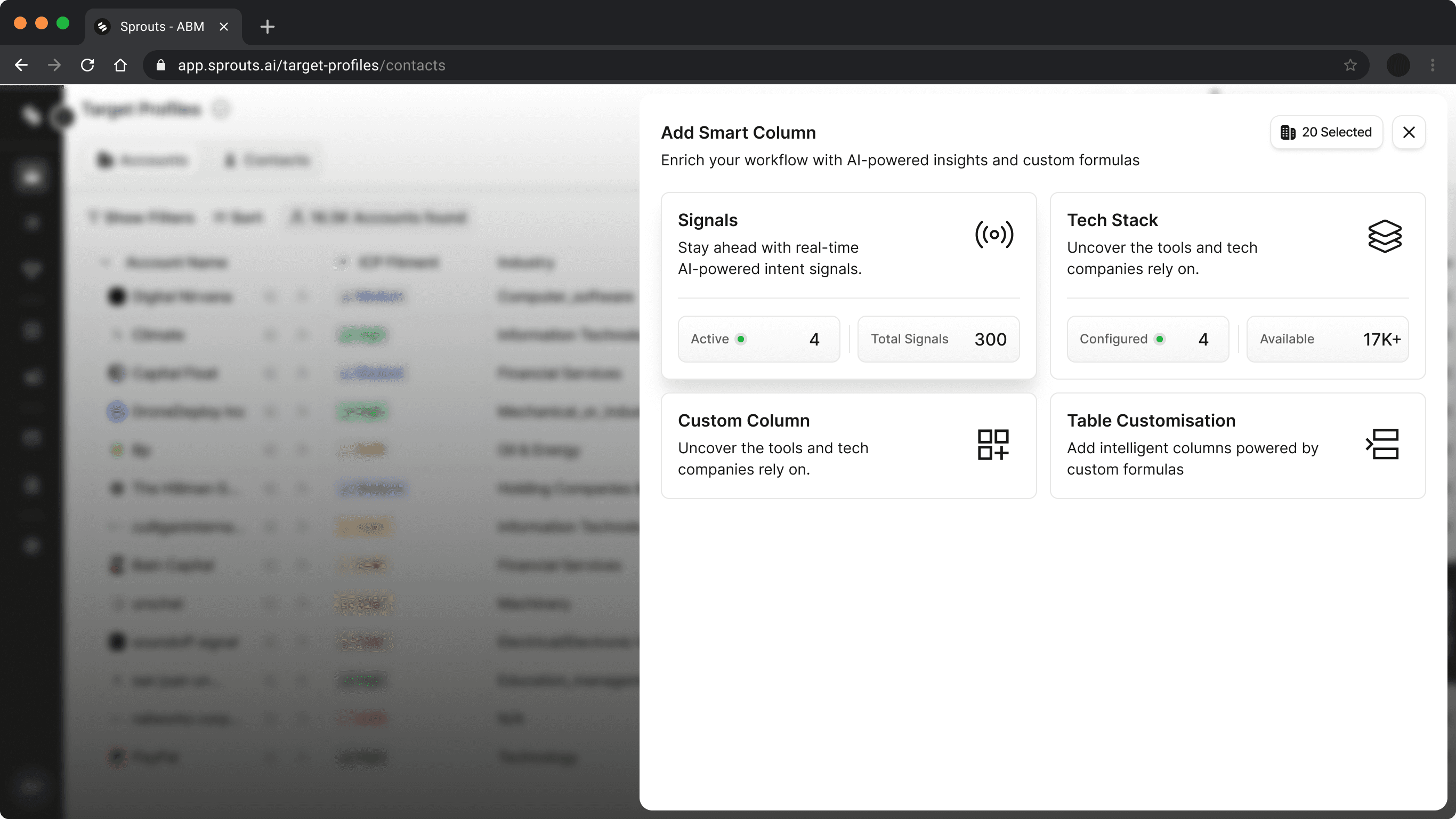
I redesigned the system to support three distinct levels of user maturity, moving from rigid configuration to conversational fluidity.
A. Structured Outputs for Programmatic Filtering
I introduced strict output formatting constraints for the AI. Instead of generic text, users could force the AI to return:
• Yes/No: Boolean logic that enables instant filtering (e.g., "Does this company use Salesforce?").
• Structured Lists (Bullets): Scannable insights for quick human review.
• Numerical Data: enabling sorting (e.g., "Filter by Hiring Growth > 20%").
Design Impact: This turned unstructured noise into database-ready signals. Users could now create "Smart Columns" that acted as logic gates for their sales campaigns.
B. Cell-Level Precision
I decoupled the signal from the "row."
• Before: Enrich "Acme Corp."
• After: Enrich only the "Recent Funding" cell for "Acme Corp." This granular control allowed users to treat the spreadsheet as a canvas, filling in only the missing gaps in their knowledge graph without burning unnecessary AI credits.
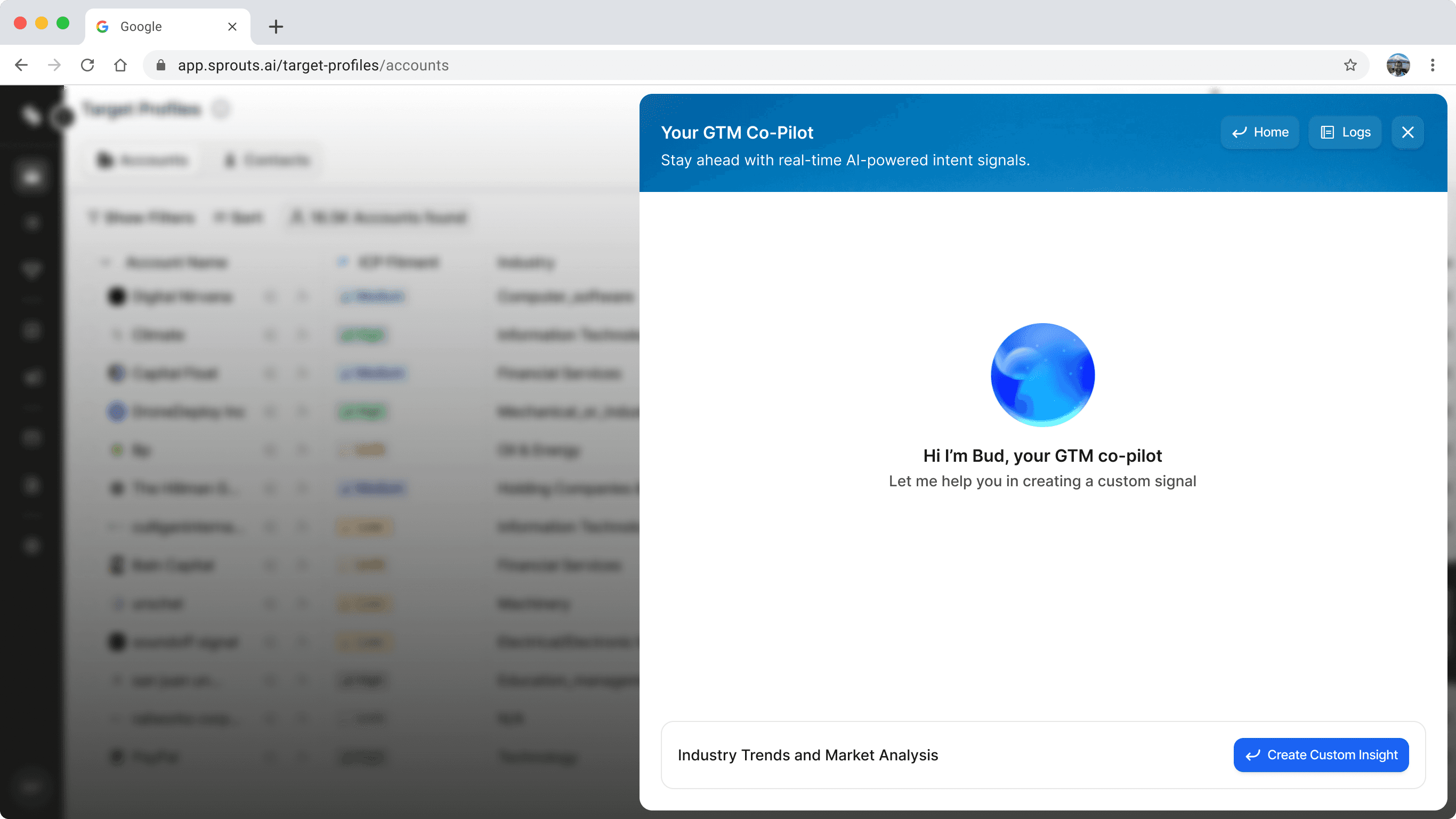
C. The "Agentic" Workflow (Conversational UI)
Recognizing that forms are high-friction, I designed a conversational interface for signal creation.
• The Shift: Instead of manually mapping "Pain Points" to "Features" via dropdowns, users can simply tell the AI: "Find companies hiring for Head of Sales and map them to our 'Sales Coaching' value prop."
• The Result: The system translates natural language intent into structured configuration, lowering the barrier to entry for non-technical sales reps.
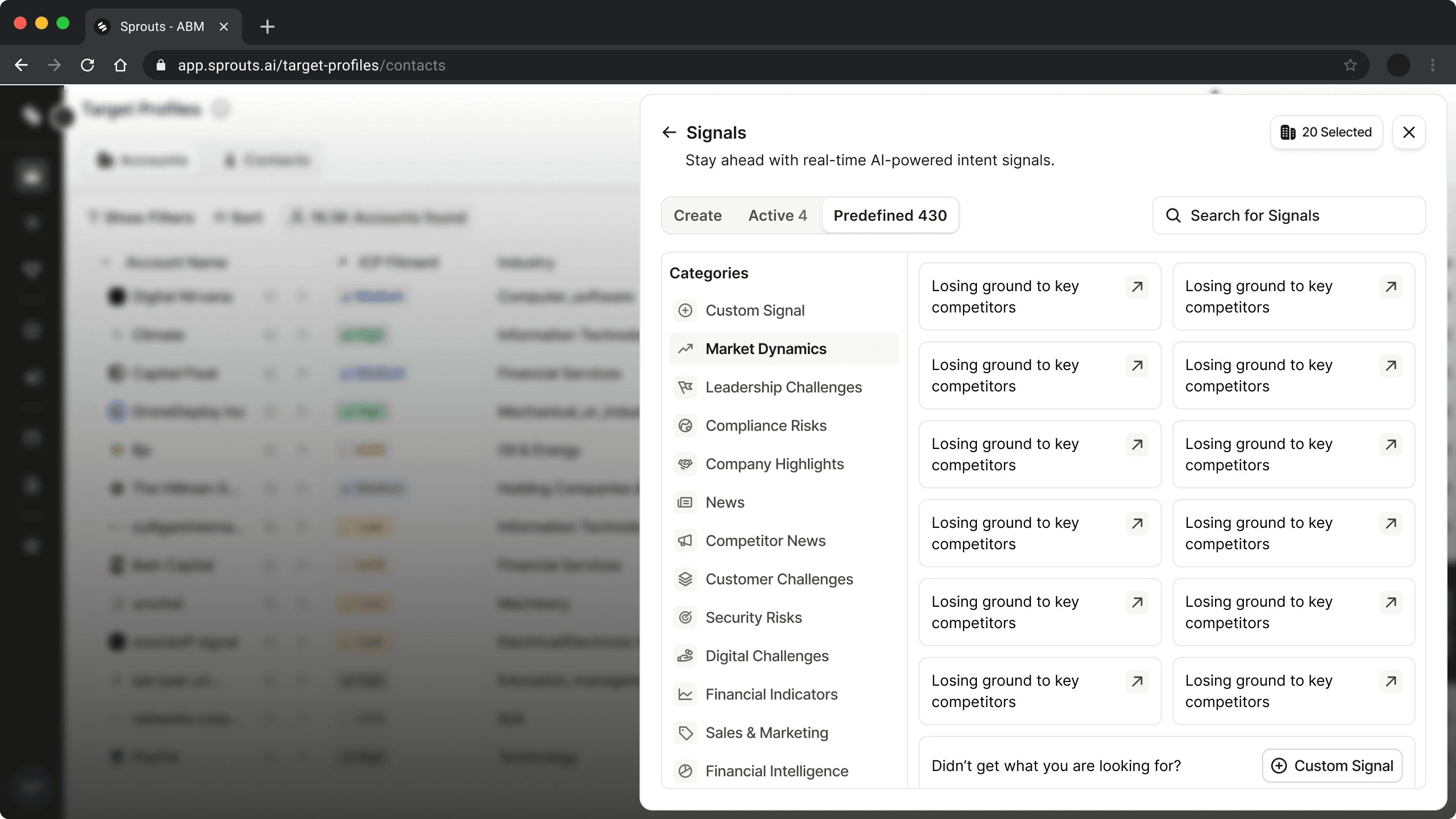
Pre-defined signal flow
Lands an TAL
Click ‘Smart Column’
User sets: Column name
Selects AI Signal
Selected AI Signals
Funding
Hiring Trend
Tach Stack
Credits & Enrichment
User sets: Column name
Enrichment type (Account / Contact)
TAL / Data Surface
User sets: Column name
Enrichment type (Account / Contact)
Signal column added to TAL
Call-level enrichment runs
Enrich call shows
Call-level enrichment runs
Signal value
Status
Expand for reasoning & sources


Custom Signal creation
User sets: Column name
Selects AI Signal
Refine with AI
Adjust scope
Short
Geography;
Short
Seniority
Gefraphy
Credits & Enrichment
User sets: Column name
Enrichment type (Account / Contact)
Read-time credit estimate
Credits deducted
Read-time shown
Signal column added to TAL
Column-level enrichment runs
Cell Level Enrichment
Column-level enrichment runs
Signal value
Status
Expand for reasoning & sources

Exploring a Conversational,
Intent-Driven Way to Create AI Signals
Reducing configuration overhead by letting users express intent in natural language, while the system translates it into structured, scalable signals.



Key Design Decisions & Trade-offs
Decision: Killing the Mandatory Preview
• Friction: Engineers worried about users wasting credits on bad prompts.
• Solution: I designed the "Preview" as an optional, non-blocking modal. Power users could "Run Immediately," trusting the system, while new users could verify the output. This reduced the time-to-execution by ~40% for recurring tasks.
Decision: The "Human-in-the-Loop" Confidence Score
• Friction: Users didn't trust the "Yes/No" AI outputs blindly.
• Solution: I added an "Expand for Reasoning" hover state. The table shows a simple "Yes," but hovering reveals the citation and source URL. This provides the speed of binary data with the trust of verifiable research.
The Impact
By moving from unstructured paragraphs to structured, cell-level data, we fundamentally changed user behavior:
• Operational Efficiency: Reduced the time from "Signal Generation" to "Outreach" by removing the need to manually read and summarize outputs.
• Adoption: The introduction of "Yes/No" signals unlocked a new use case—automated list cleaning—which saw immediate adoption by RevOps personas who previously ignored the feature.
• Scalability: The system laid the UI foundation for future "Agentic" workflows, where the AI can not only find the signal but act on it autonomously based on the structured data I designed.
Reflection
This project taught me that in AI design, format is function. The most powerful AI is useless if the output cannot be easily ingested by the user's workflow. By structuring the AI's output, I didn't just design a better table; I designed a system that allows sales teams to program their own growth.